In the middle of Nowhere, South Africa Built a Racetrack for 1 000 km/h
There’s a patch of cracked earth in the Northern Cape where almost nothing happens. Except, once, a car went past at 1,010 km/h.
At first glance, Hakskeen Pan doesn’t look like the home of one of the most ridiculous automotive engineering projects ever attempted.
There are no grandstands. No pit lane. No Armco barriers.
Actually, there isn’t much of anything.
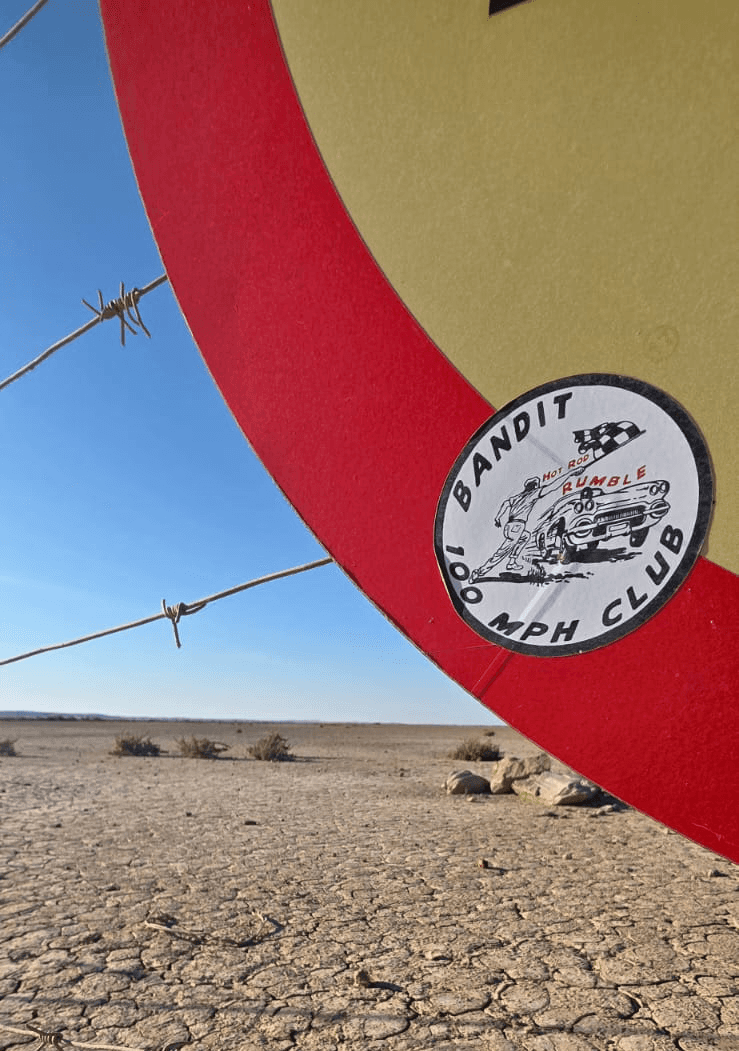
Just an enormous stretch of hard, flat earth disappearing into the Kalahari, close to the Namibian border. Blue sky. Heat. A few tyre tracks. And, if you know where to look, little reminders left behind by the people who have made the journey out here.
But this isn’t just another empty pan in the Northern Cape.
This is where someone decided 1,000 km/h wasn’t fast enough.
Welcome to Hakskeen Pan
Land-speed racing has always existed somewhere between motorsport and complete insanity.
Normal racing asks how quickly you can get around a circuit.
Land-speed racing asks a much simpler question:
How fast can we possibly make something with wheels go?
The current outright world land-speed record stands at 763.035 mph or 1,227.985 km/h, set by British RAF pilot Andy Green in ThrustSSC in Nevada’s Black Rock Desert in 1997.
It was the first car to officially break the sound barrier.
Then came another idea.
Build a car capable of 1,000 mph.
That’s 1,609 km/h.
And somehow, the road to attempting it led to a dry lake bed in South Africa.
Finding the world’s longest racetrack
To understand why Hakskeen Pan was chosen, you have to understand the problem with trying to drive at these speeds.
You don’t just need somewhere flat.
You need somewhere absurdly flat, incredibly long and exceptionally clear.
Hakskeen Pan had the space.
But it wasn’t ready for a car travelling close to the speed of sound.
So members of the local Mier community helped turn it into something extraordinary.
Hundreds of people worked to clear the surface by hand.
Around 16,500 tons of stone were removed from roughly 22 million square meters of dry lake bed, creating what the Bloodhound team would eventually describe as an exceptional straight-line racing surface.
No asphalt.
No multimillion-rand circuit construction.
Just kilometers upon kilometers of carefully prepared Kalahari earth.
It became one of the strangest racetracks on the planet.
Then they brought a fighter jet with wheels
Calling Bloodhound LSR a “car” feels slightly generous to the word car.
It is more like someone looked at a fighter jet, a racing car and a missile and decided they should probably be one thing.
At the heart of it was a Rolls-Royce EJ200 jet engine, the type of engine used in the Eurofighter Typhoon. And in October and November 2019, Bloodhound arrived at Hakskeen Pan for high-speed testing.
The plan wasn’t yet to break the world record.
First, they needed to find out whether the machine, and the surface underneath it, could actually handle what they wanted to do.
Speeds increased run by run.
Then, on 16 November 2019, Andy Green put his foot down.
Bloodhound accelerated from standstill to 628 mph, 1,010 km/h, in just 50 seconds.
Think about that number for a second.
At 1,010 km/h you’re covering roughly 280 meters every second.
A kilometer disappears in about three and a half seconds.
And this wasn’t happening on some purpose-built European test facility.
It was happening right here.
In the Northern Cape.
At 1,010 km/h you’re covering roughly 280 meters every second. A kilometer disappears in about three and a half seconds.
But it didn’t break the record
This is where the story gets slightly complicated.
You’ll often hear Hakskeen Pan referred to in connection with “the land-speed record”, but Bloodhound’s 1,010 km/h run wasn’t a new world record.
The existing 1,227.985 km/h record remained untouched.
The 2019 runs were high-speed testing for what was supposed to come next.
Bloodhound was ultimately designed to add rocket power alongside the jet engine and make an assault on the record, with the project’s famous stretch goal of reaching 1,000 mph.
The testing proved something important: the car could run at extraordinary speeds on Hakskeen Pan, and the team believed the data showed it was capable of going considerably faster.
But projects this ambitious require equally ridiculous amounts of money.
The record attempt didn’t follow as originally planned.
So Hakskeen Pan never got its 1,000 mph moment.
At least, not yet.
Which somehow makes standing there even cooler
Visit Hakskeen Pan today and that’s perhaps the strangest part.
There isn’t some giant monument announcing what happened here.
The landscape has gone back to doing what it has done for a very long time:
Being almost completely empty.
And yet, for a few weeks in 2019, engineers, support crews and one of the fastest drivers in history came to this remote piece of South Africa to answer a question that car people have been asking since the car was invented:
Can we make it go faster?
The answer was 1,010 km/h.
And then:
Probably.
The places car people leave their mark
There are stickers on the signs around the pan now.
Rally groups. Clubs. People who drove hundreds of kilometers across South Africa to stand in exactly this spot.
They’re tiny against the scale of Hakskeen.
But maybe that’s the point.
Because car culture isn’t only about the cars sitting in garages.
It’s the roads people drive to find places like this.
It’s knowing why an otherwise empty piece of cracked earth matters.
It’s seeing a sticker on the back of a sign in the middle of nowhere and immediately understanding that somebody else came here for exactly the same reason you did.
Hakskeen Pan may never look like a racetrack.
But in 2019, a jet-powered car crossed this piece of South African dirt at 1,010 km/h.
And if you’re the kind of person who thinks that’s worth driving into the middle of nowhere to see? You get it.
Build it. Drive it. Share it.